
What Are the Benefits of Email Marketing?
In the ever-evolving world of digital marketing, new platforms and trends keep emerging — from short-form videos to AI-driven advertising. Yet, one channel continues to deliver consistent, measurable, and scalable results: email marketing.
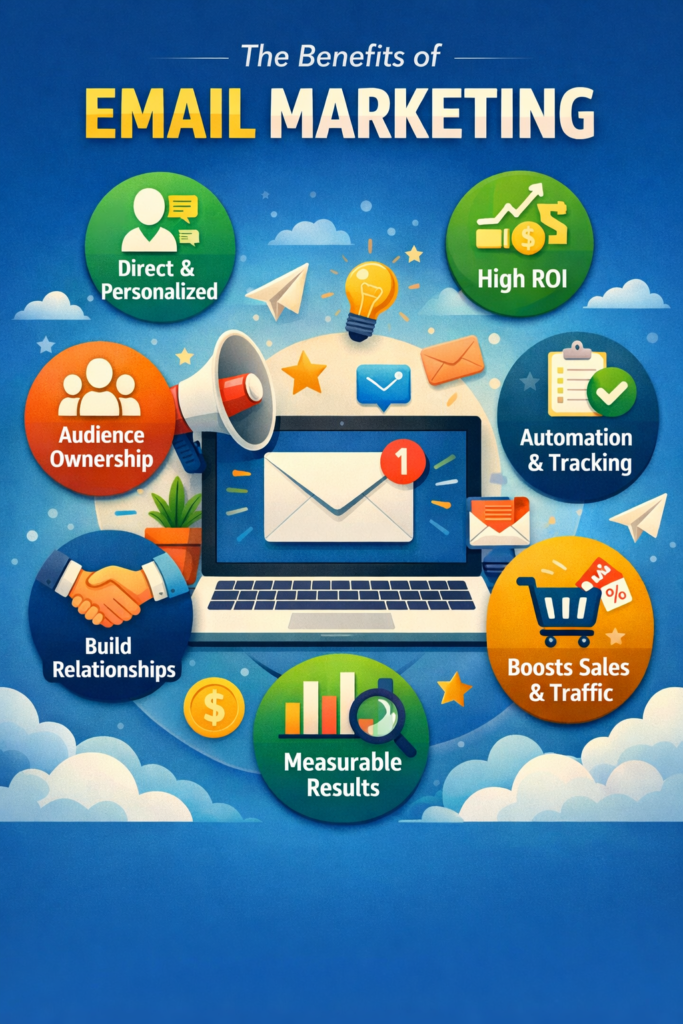
Despite being one of the oldest digital communication tools, email marketing remains one of the most powerful ways for businesses to connect with their audience, nurture leads, and generate revenue. Whether you are a startup, a freelancer, a coach, or a large enterprise, email marketing can become your most reliable growth engine.
In this article, we’ll explore the key benefits of email marketing and why it should be a core part of your marketing strategy.
1. Direct and Personalized Communication
One of the biggest advantages of email marketing is direct access to your audience’s inbox. Unlike social media platforms where algorithms decide who sees your content, email gives you a direct line of communication with your subscribers.
When someone shares their email address with you, they are giving you permission to contact them. This makes email marketing a permission-based channel, which increases trust and engagement.
Moreover, email marketing allows deep personalization:
- Addressing subscribers by name
- Sending content based on their interests
- Recommending products based on previous purchases
- Sending location-based offers
Personalized emails can significantly improve open rates and conversion rates. People respond better when they feel the message is crafted specifically for them.
2. High Return on Investment (ROI)
Email marketing consistently delivers one of the highest ROIs among digital marketing channels. Businesses often find that for every rupee or dollar spent on email campaigns, they generate multiple times in revenue.
Why is the ROI so high?
- Low operational costs
- No printing or distribution expenses
- Automation reduces manpower
- Targeted messaging increases conversions
Once your email list is built, the cost of sending campaigns is relatively low compared to paid ads. You are not paying for impressions every time you send a message — you are leveraging an asset you already own: your subscriber list.
3. Ownership of Your Audience
Social media platforms can change algorithms, restrict reach, or even suspend accounts. Businesses that depend entirely on platforms like Instagram, Facebook, or LinkedIn are at the mercy of these changes.
With email marketing, you own your list.
No algorithm can stop your email from being delivered (unless it violates policies). Your database becomes a long-term business asset that you can use anytime — for product launches, promotions, announcements, or brand storytelling.
This ownership creates stability in your marketing strategy.
4. Builds Strong Customer Relationships
Email marketing is not just about selling. It’s about building relationships.
Through regular newsletters, educational content, industry updates, and helpful resources, you stay connected with your audience. Over time, this consistent communication builds:
- Trust
- Brand recall
- Authority
- Loyalty
When subscribers repeatedly receive value from your emails, they begin to see you as a reliable source. This increases the likelihood that they will choose your product or service when they are ready to make a purchase.
5. Effective Lead Nurturing
Most customers do not buy immediately after discovering your business. They go through a journey — awareness, consideration, evaluation, and decision.
Email marketing helps you nurture leads at every stage of this journey.
For example:
- Welcome emails introduce your brand
- Educational emails explain your services
- Case studies build credibility
- Testimonials reduce hesitation
- Limited-time offers create urgency
Through automated email sequences, you can guide prospects step-by-step toward conversion without manual follow-ups.
6. Automation Saves Time and Effort
Modern email marketing tools allow automation. This means you can create email sequences that are triggered automatically based on user behavior.
Examples of automation:
- Welcome emails after signup
- Cart abandonment reminders
- Birthday or anniversary offers
- Follow-up emails after downloads
- Re-engagement campaigns for inactive subscribers
Automation ensures that the right message reaches the right person at the right time — without constant manual effort. This improves efficiency and allows businesses to scale smoothly.
7. Measurable and Data-Driven
Email marketing is highly measurable. You can track:
- Open rates
- Click-through rates
- Bounce rates
- Conversion rates
- Unsubscribe rates
These insights help you understand what is working and what needs improvement.
For example:
- If open rates are low, your subject lines may need improvement.
- If clicks are low, your content or call-to-action may need optimization.
- If conversions are low, your landing page may need enhancement.
This data-driven approach helps you continuously refine your strategy for better results.
8. Increases Website Traffic
Every email you send can drive traffic to your website.
By including:
- Blog links
- Product pages
- Service details
- Event registrations
- Webinar sign-ups
You encourage subscribers to visit your site. This not only increases engagement but also improves opportunities for conversions.
Consistent email campaigns ensure that your audience regularly returns to your website, strengthening your online presence.
9. Boosts Sales and Revenue
Email marketing directly contributes to revenue growth.
You can use email campaigns for:
- Product launches
- Flash sales
- Discount offers
- Cross-selling
- Upselling
- Seasonal promotions
Because your subscribers have already shown interest in your brand, they are more likely to convert compared to cold audiences.
Targeted promotions based on customer behavior (like previous purchases) can significantly increase average order value.
10. Cost-Effective Marketing Channel
Compared to traditional marketing methods such as print ads, TV ads, or radio, email marketing is extremely cost-effective.
You do not need:
- Physical materials
- Printing
- Distribution logistics
Even small businesses with limited budgets can run professional email campaigns. Many email marketing platforms offer affordable plans suitable for startups and freelancers.
This makes email marketing accessible to businesses of all sizes.
11. Enhances Brand Awareness
Consistency builds brand recognition.
When subscribers regularly see your:
- Logo
- Brand colors
- Tone of voice
- Messaging style
They begin to recognize and remember your brand.
Even if they do not immediately buy, repeated exposure keeps your business top-of-mind. When they eventually need your product or service, your brand is more likely to be remembered.
12. Segmentation Improves Targeting
Not all subscribers are the same. Email marketing allows you to segment your audience based on:
- Age
- Location
- Purchase history
- Interests
- Engagement level
Segmentation ensures that subscribers receive content relevant to them. For example:
- New subscribers receive introductory emails.
- Existing customers receive loyalty offers.
- Inactive users receive re-engagement campaigns.
This relevance increases open rates, engagement, and conversions.
13. Supports Other Marketing Channels
Email marketing does not work in isolation — it strengthens your entire marketing ecosystem.
You can use email to:
- Promote social media campaigns
- Drive webinar registrations
- Share YouTube videos
- Announce blog posts
- Encourage app downloads
It becomes a central communication channel that amplifies all your other marketing efforts.
14. Scalable for Business Growth
As your business grows, your email marketing efforts can scale with it.
Whether you have:
- 500 subscribers
- 5,000 subscribers
- 50,000 subscribers
The process remains similar. Automation, segmentation, and analytics allow you to manage large audiences efficiently without significantly increasing costs.
This scalability makes email marketing suitable for long-term business growth.
15. Builds Customer Loyalty and Retention
Acquiring a new customer is often more expensive than retaining an existing one.
Email marketing helps improve retention through:
- Regular updates
- Exclusive offers
- Loyalty rewards
- Helpful tips and guides
- Post-purchase follow-ups
When customers feel valued and engaged, they are more likely to stay loyal to your brand and make repeat purchases.
16. Encourages Two-Way Communication
Email is not just a broadcasting tool — it encourages interaction.
Subscribers can:
- Reply to emails
- Ask questions
- Provide feedback
- Share concerns
This direct communication strengthens relationships and gives valuable insights into customer needs.
17. Improves Conversion Rates
Email subscribers are typically warmer leads compared to general website visitors.
They have:
- Opted in voluntarily
- Shown interest in your brand
- Engaged with previous communication
Because of this, email campaigns often achieve higher conversion rates compared to many other digital channels.
Conclusion
Email marketing is far from outdated. In fact, it remains one of the most powerful, cost-effective, and scalable marketing tools available today.
Its key benefits include:
- Direct communication
- High ROI
- Audience ownership
- Strong relationship building
- Effective lead nurturing
- Automation capabilities
- Measurable performance
- Increased traffic and sales
- Scalability and long-term growth
In a digital landscape filled with constant algorithm changes and rising ad costs, email marketing offers stability and control. It gives businesses the power to build lasting relationships, drive consistent revenue, and create meaningful engagement.
Whether you are just starting out or already running a successful business, investing in email marketing can significantly strengthen your overall marketing strategy.
If implemented strategically with valuable content and smart automation, email marketing can become your most dependable and profitable marketing channel.

Related Posts