Travel Agency Digital Marketing Guide
Travel agencies operate in a highly competitive digital environment where potential customers research destinations, compare packages, watch travel videos, read reviews, and contact multiple agencies before making a booking. For this reason, a strong online advertising strategy can play an important role in attracting attention and generating enquiries.
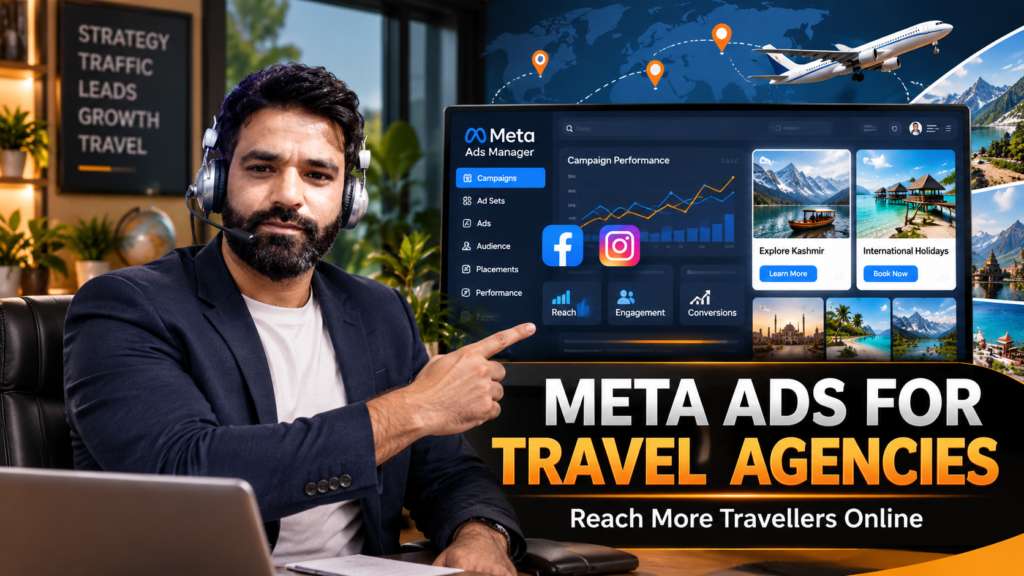
Meta Ads for travel agencies can help businesses promote destinations, tour packages, honeymoon trips, family holidays, group tours, and customised travel experiences across Facebook and Instagram. When campaigns are built around clear business goals, relevant audiences, strong creative content, and proper conversion tracking, Meta advertising can become an important part of a travel agency’s digital marketing strategy.
What Are Meta Ads for Travel Agencies?
Meta Ads are paid advertising campaigns distributed through Meta’s advertising ecosystem, including Facebook and Instagram placements. Travel agencies can use these campaigns to introduce destinations, promote packages, generate leads, encourage enquiries, or build awareness among people who may be interested in travelling.
Unlike a traditional travel brochure, digital advertising allows agencies to create different campaigns for different audiences and destinations. For example, a family holiday campaign can use different creative content and messaging from a honeymoon package or adventure tour.
This flexibility makes Meta Ads particularly relevant to travel businesses, where customer preferences, destinations, seasons, budgets, and trip types can vary significantly.
Why Meta Ads Can Be Valuable for Travel Agencies
Travel is a highly visual industry. People often want to see destinations, hotels, activities, landscapes, itineraries, and experiences before deciding to enquire. Facebook and Instagram provide travel brands with environments where visual content can attract attention and communicate the experience behind a package.
A well-planned campaign can help a travel agency:
- Promote specific destinations and tour packages
- Reach selected audience segments
- Generate enquiries through forms or messaging
- Build awareness for a travel brand
- Reconnect with people who have interacted with the business online
- Test different creative concepts and marketing messages
However, advertising performance depends on many factors, including offer quality, campaign setup, audience relevance, creative quality, landing page experience, follow-up process, and overall market demand.
1. Define Your Travel Agency’s Advertising Goal
Before launching Meta Ads, decide what the campaign is actually trying to achieve. A travel agency may want more WhatsApp conversations, lead form submissions, website enquiries, bookings, or brand awareness.
The campaign structure should reflect that goal. A company focused on lead generation should not evaluate success only by impressions or likes. Instead, it should measure meaningful actions such as qualified enquiries and, where possible, completed bookings.
Clear objectives make it easier to evaluate whether the campaign is producing business value.
2. Choose the Right Audience for Each Travel Package
One of the biggest advantages of digital advertising is the ability to structure campaigns around different audiences. Travel agencies should avoid treating every traveller as the same customer.
A honeymoon campaign may require different messaging from a family holiday campaign. An adventure package may appeal to a different audience from a luxury vacation.
Audience planning can consider factors such as travel interests, destination relevance, customer intent, previous interactions, age groups where appropriate, and geographic relevance.
The objective is not simply to reach more people. It is to reach people who are more relevant to the offer being promoted.
3. Create Travel Ads That Sell the Experience
A travel ad needs to communicate more than a destination name. The creative should quickly answer the question: why should someone care about this trip?
Effective travel advertising can highlight the destination, itinerary, type of experience, convenience, inclusions, or a specific reason to consider the package.
Use high-quality destination imagery and videos where appropriate. Keep the message easy to understand and make the next step clear.
Depending on the campaign, the call to action may encourage people to enquire, send a message, learn more, or view a package.
4. Build Dedicated Landing Pages for Travel Campaigns
Sending every ad to a generic homepage can create unnecessary friction. A better approach is often to connect the advertisement with a relevant destination or package page.
For example, an ad promoting a Kashmir holiday should ideally lead to a page where visitors can immediately understand the itinerary, hotel options, inclusions, transportation, pricing information where appropriate, FAQs, and enquiry process.
Good landing pages should be mobile-friendly, easy to navigate, and focused on the action you want visitors to take.
Learn more about website design services and how professional website structure can support digital marketing campaigns.
5. Use Lead Generation and Messaging Campaigns
Travel agencies often need conversations before a customer is ready to book. Travellers may ask about hotels, dates, transportation, itinerary customisation, or package inclusions.
Meta advertising can be structured around lead generation or messaging, depending on the agency’s sales process and campaign objectives.
Lead forms should ask for information that genuinely helps the sales team qualify the enquiry. Overly complicated forms may reduce submissions, while extremely broad forms can generate enquiries that are difficult to qualify.
For many travel businesses, the speed and quality of follow-up after receiving a lead can be just as important as the advertising itself.
6. Retarget People Who Already Know Your Brand
Not every traveller books immediately after seeing an advertisement. Someone might watch a travel video, visit a package page, view an itinerary, or interact with the agency’s social media content and then continue researching.
Retargeting can help travel businesses reconnect with audiences who have previously interacted with their online presence, where the appropriate tracking, permissions, and platform features are in place.
Retargeting messages should provide a useful reason to return, such as more information about an itinerary, a destination guide, a booking consultation, or a relevant package update.
7. Test Multiple Creatives
There is rarely one creative format that works equally well for every travel audience. Agencies can test different images, short-form videos, hooks, calls to action, and destination messages.
For example, one campaign may use a destination-focused image while another uses an itinerary-based video. Testing can help identify which creative ideas attract stronger engagement or more meaningful enquiries.
Testing should be structured. Change one meaningful variable at a time where practical, and judge the results based on the campaign objective rather than superficial engagement alone.
8. Measure Qualified Leads, Not Just Clicks
A travel campaign can receive many clicks without generating profitable business. This is why measurement needs to go beyond reach, impressions, and traffic.
Depending on the agency’s setup, useful metrics may include:
- Qualified enquiries
- Lead volume
- Cost per lead
- Messaging conversations
- Landing page conversions
- Booking conversions where reliable attribution exists
- Return on advertising spend where measurable
Accurate measurement helps the agency identify which campaigns contribute to real business outcomes.
9. Combine Meta Ads with SEO and Google Ads
Meta Ads do not have to operate in isolation. A travel agency can combine paid social advertising with organic search, Google Ads, local search visibility, and a strong website.
SEO services can support long-term organic visibility for destination pages and travel content, while Google Ads services can help capture selected search demand.
The customer journey may begin with an Instagram travel video, continue with a Google search, and end with a website enquiry. A connected digital strategy helps businesses understand these different touchpoints.
10. Improve Local Visibility for Travel Agencies
Travel agencies that depend on customers from specific cities or regions should also pay attention to local online visibility.
Accurate business information, a well-maintained Google Business Profile, useful local pages, customer reviews, and relevant local content can support local discovery.
Travel businesses can explore Local SEO services as part of a wider digital strategy for improving local search visibility.
11. Connect Meta Ads to a Strong Travel Website
Advertising can generate attention, but your website still needs to answer the traveller’s questions. A strong website should clearly present destinations, tour packages, itineraries, inclusions, contact options, FAQs, and booking information.
Mobile usability is particularly important because travellers frequently research trips from smartphones. Pages should load efficiently, information should be easy to find, and enquiry options should be visible without creating unnecessary barriers.
Explore Shoiab Ganai’s digital marketing services for information about combining search, advertising, websites, analytics, and digital strategy.
12. Why Travel Agencies Need a Complete Meta Ads Strategy
Running Meta Ads successfully is not simply about pressing the “boost” button. A professional approach requires campaign planning, audience research, creative development, conversion tracking, landing page alignment, testing, and ongoing optimisation.
For travel agencies, the strategy should also account for seasonality, destinations, package margins, booking cycles, customer intent, and operational capacity.
Shoiab Ganai provides digital marketing services covering Meta Ads, SEO, Local SEO, Google Ads, website design, analytics, and digital strategy. You can review available work through the case studies and portfolio.
Common Meta Ads Mistakes Travel Agencies Should Avoid
- Running campaigns without a clear objective
- Using the same creative for every audience
- Sending all traffic to an irrelevant homepage
- Ignoring lead quality
- Failing to track important conversions
- Changing campaigns too frequently without enough evidence
- Promoting offers without explaining what is included
- Ignoring follow-up speed after receiving enquiries
Avoiding these mistakes can make campaign evaluation more meaningful and help businesses identify where improvements are needed.
Meta Ads Strategy for Different Types of Travel Agencies
Family Travel Agencies
Focus on convenience, family-friendly experiences, accommodation, sightseeing, and trip planning information relevant to parents and groups.
Honeymoon Travel Agencies
Emphasise destination experiences, privacy, itinerary flexibility, accommodation choices, and memorable travel experiences.
Adventure Travel Agencies
Use strong visuals that communicate activities, destinations, safety information, and the type of traveller the experience is designed for.
International Travel Agencies
Provide clear destination information and make it easy for travellers to understand package details, documentation requirements, accommodation, transport, and support.
How to Build a Better Meta Ads Funnel for a Travel Agency
A practical travel advertising funnel can begin with awareness-focused creative that introduces a destination or travel experience. Interested users can then interact with destination content or visit a relevant page. Follow-up campaigns can encourage further research or enquiry, while lead management helps the agency move qualified prospects toward booking.
The exact structure should depend on your audience, website, sales process, package value, and campaign objective. There is no universal funnel that works for every travel agency.
How Much Should a Travel Agency Spend on Meta Ads?
There is no single correct Meta Ads budget for every travel business. Budget decisions should consider the value of a booking, destination competition, seasonality, available audience size, sales capacity, and the agency’s ability to follow up with leads.
It is usually more useful to start with a clearly defined objective and measurable campaign structure than to choose a budget without a measurement framework.
Travel agencies should also distinguish between advertising spend and digital marketing service fees when evaluating the total cost of customer acquisition.
Frequently Asked Questions About Meta Ads for Travel Agencies
Are Meta Ads effective for travel agencies?
Meta Ads can be useful for travel agencies because travel is highly visual and customers often discover destinations through social content. Campaign performance depends on strategy, audience relevance, creative quality, offer quality, and conversion setup.
What should a travel agency advertise on Facebook and Instagram?
Agencies can promote holiday packages, honeymoon trips, family tours, group departures, destination experiences, seasonal campaigns, and customised travel services.
Should travel agencies use lead forms or WhatsApp campaigns?
Either can be appropriate depending on the agency’s sales process. Lead forms can collect structured customer information, while messaging campaigns can be useful when travellers need conversation before making an enquiry.
Can Meta Ads generate bookings directly?
They can contribute to the booking journey, but actual booking performance depends on the offer, website or sales process, lead quality, follow-up, and many other factors. Advertising should be evaluated using meaningful business outcomes.
Should travel agencies combine Meta Ads with Google Ads?
They can work together. Meta Ads can support discovery and audience engagement, while Google Ads can capture selected active search demand. The right combination depends on the agency’s goals and customer journey.
How can I improve Meta Ads lead quality for my travel agency?
Use relevant audience targeting, clear package messaging, appropriate lead questions, strong landing pages, conversion tracking, creative testing, and fast follow-up.
Conclusion: Use Meta Ads as Part of a Complete Travel Marketing Strategy
Meta Ads for travel agencies can provide an effective way to showcase destinations, introduce travel packages, reach relevant audiences, and generate customer enquiries. But strong results do not come from advertising alone.
Travel businesses need a combination of compelling creative, audience strategy, relevant landing pages, conversion tracking, customer follow-up, and continuous optimisation. Meta Ads can become even more valuable when integrated with SEO, Local SEO, Google Ads, content marketing, analytics, and professional website design.
If you are a travel business looking to improve your online visibility and advertising strategy, explore Shoiab Ganai and the available digital marketing services for SEO, Meta Ads, Google Ads, Local SEO, websites, and analytics.
Author: Shoiab Ganai
Professional Focus: Digital Marketing, SEO, Local SEO, Meta Ads, Google Ads, Analytics and Website Strategy
Website: https://shoiabganai.com/