
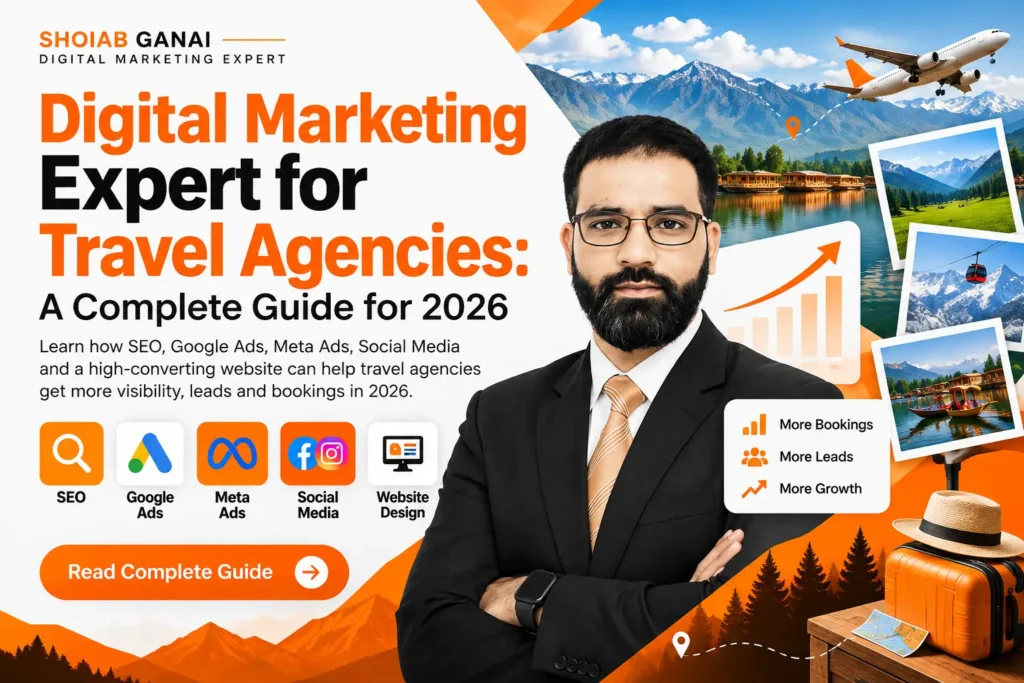
The travel industry has become increasingly digital. Travelers now use search engines, maps, social media, video platforms, online reviews and AI-powered search tools to research destinations, compare tour packages and choose travel companies.
For travel agencies, this creates an important opportunity: building a strong digital presence can help the right customers discover your business when they are actively planning a trip.
A digital marketing expert for travel agencies can help combine search engine optimization, Local SEO, Google Ads, Meta Ads, content marketing, website optimization, social media and emerging search strategies such as Answer Engine Optimization (AEO) and Generative Engine Optimization (GEO).
In this comprehensive guide, we explain how travel agencies can build a practical digital marketing strategy in 2026 and turn online visibility into qualified enquiries and bookings.
If you are looking for professional digital marketing services, explore digital marketing services by Shoiab Ganai .
What Is a Digital Marketing Expert for Travel Agencies?
A digital marketing expert for travel agencies is a professional who develops and manages online marketing strategies designed specifically for travel businesses, tour operators and tourism companies.
Travel marketing is different from many other industries because customers often research extensively before making a purchase. A traveler may search for a destination, compare packages, read reviews, check photographs, watch videos and contact several agencies before making a final decision.
A travel-focused digital marketing strategy therefore needs to address the complete customer journey from discovery to enquiry and booking.
What Can a Travel Digital Marketing Expert Help With?
- Search engine optimization
- Local SEO
- Google Ads
- Meta Ads
- Social media marketing
- Content marketing
- Travel website optimization
- Landing page optimization
- Lead generation
- Conversion rate optimization
- Online reputation management
- Answer Engine Optimization
- Generative Engine Optimization
Why Do Travel Agencies Need Digital Marketing in 2026?
Travelers increasingly begin their trip planning online. They may use Google , Bing , Yahoo , YouTube, social media platforms and AI-powered search experiences while researching a destination.
This means a travel agency needs to be visible at multiple stages of the travel research journey.
The Modern Travel Customer Journey
- The traveler discovers a destination.
- The traveler searches for information.
- The traveler compares tour packages.
- The traveler checks prices and itineraries.
- The traveler reviews travel agencies.
- The traveler checks Google Maps and reviews.
- The traveler visits social media profiles.
- The traveler contacts one or more agencies.
- The traveler compares quotations.
- The traveler makes a booking.
A strong digital marketing strategy should support this entire journey rather than focusing only on website traffic.
Digital Marketing Strategies for Travel Agencies
Travel agencies can use multiple digital marketing channels together to create a complete customer acquisition system.
SEO for Travel Agencies
Search engine optimization can help travel agencies attract people searching for destinations, packages, travel services and travel information.
Examples of travel-related searches include:
- Kashmir tour packages
- Kashmir honeymoon packages
- Kashmir family tour packages
- Kashmir tour packages from Delhi
- Gulmarg tour packages
- Pahalgam tour packages
- Sonmarg tour packages
- travel agency in Srinagar
- best travel agency for Kashmir
- budget Kashmir tour packages
A successful travel SEO strategy should target both commercial keywords and informational searches.
Travel agencies looking for professional SEO support can learn more about SEO services .
Local SEO for Travel Agencies
Local SEO is particularly useful for travel agencies that serve customers from a particular city or region.
Potential customers may search for terms such as:
- Travel agency near me
- Travel agency in Srinagar
- Kashmir travel agency
- Tour operator in Srinagar
- Travel company near me
A properly optimized Google Business Profile, accurate business information, genuine customer reviews, relevant photographs and locally focused content can support local visibility.
Learn more about Local SEO services for improving local search visibility.
Google Ads for Travel Agencies
Google Ads can provide paid visibility when travelers are actively searching for destinations, tour packages and travel services.
For example, an agency targeting the search term “Kashmir honeymoon package” can create a dedicated advertisement and send potential customers to a relevant honeymoon package landing page.
Travel agencies can use different campaigns for:
- Honeymoon packages
- Family packages
- Luxury packages
- Budget packages
- Group tours
- Destination packages
- Taxi services
- Hotel booking services
Learn more about Google Ads services for targeted paid search campaigns.
Travel advertisers can also use the official Google Ads platform to manage advertising campaigns.
Meta Ads for Travel Agencies
Travel is highly visual, making platforms such as Facebook and Instagram useful channels for destination marketing.
Travel agencies can promote:
- Destination videos
- Travel reels
- Tour packages
- Hotel experiences
- Customer testimonials
- Seasonal offers
- Travel itineraries
- Customized holiday packages
A travel agency can create campaigns that introduce potential customers to a destination and later retarget people who have interacted with its content or website.
Learn more about Meta Ads services .
Travel businesses can also access Meta advertising tools and Meta Business tools for campaign management.
Social Media Marketing for Travel Agencies
Social media allows travel agencies to combine destination inspiration, educational information, customer experiences and commercial offers.
Destination Content
- Best places to visit
- Hidden destinations
- Things to do
- Scenic locations
- Local experiences
Educational Travel Content
- Best time to visit
- Travel tips
- Packing guides
- Weather information
- Travel budgets
Trust-Building Content
- Customer testimonials
- Travel photographs
- Video testimonials
- Behind-the-scenes content
- Customer experiences
The objective should be to combine inspiration, information, trust and conversion rather than publishing promotional content exclusively.
Content Marketing for Travel Agencies
Content marketing can help travel agencies build topical authority around their destinations and services.
For example, a travel agency specializing in Kashmir could create a central Kashmir Travel Guide and support it with detailed articles about destinations, itineraries, budgets and travel planning.
Example Kashmir Content Cluster
- Kashmir Travel Guide
- Best Places to Visit in Kashmir
- Best Time to Visit Kashmir
- Kashmir Itinerary for 5 Days
- Kashmir Itinerary for 7 Days
- Kashmir Honeymoon Guide
- Kashmir Family Travel Guide
- How Much Does a Kashmir Trip Cost?
- Gulmarg Travel Guide
- Pahalgam Travel Guide
- Sonmarg Travel Guide
These informational articles can naturally link to relevant commercial pages, including tour packages and enquiry pages.
Website Design for Travel Agencies
A travel agency website should make it easy for visitors to understand the company’s destinations, packages, services and booking process.
A travel website should clearly communicate:
- Where the agency operates
- Which destinations are available
- Available tour packages
- Package duration
- Itineraries
- What’s included
- What’s excluded
- How customers can contact the agency
- Customer reviews and testimonials
A professional website design service can help create a website focused on usability, search visibility and conversions.
WhatsApp Marketing for Travel Agencies
WhatsApp can be an important communication channel for travel businesses because travelers often want quick answers about prices, dates, hotels and itineraries.
A travel agency can use website and social media CTAs such as:
Plan Your Trip on WhatsApp
The enquiry process can collect information such as destination, travel dates, number of travelers, preferred hotel category and approximate budget.
Online Reviews and Reputation Management
Trust plays an important role when travelers choose between competing agencies. Potential customers may review a company’s Google Business Profile, website, social media profiles and other online platforms before contacting the business.
Travel agencies should encourage genuine customers to leave honest reviews after completing their trips.
Businesses should avoid fake or misleading reviews. Authentic customer experiences provide more meaningful long-term trust.
Answer Engine Optimization (AEO) for Travel Agencies
Answer Engine Optimization, commonly referred to as AEO, focuses on creating content that provides clear and useful answers to questions users ask through search engines and answer-based search systems.
Travelers frequently search using questions rather than traditional keywords.
Examples of Travel Questions
- What is the best time to visit Kashmir?
- How many days are enough for Kashmir?
- What is the best Kashmir itinerary for families?
- How much does a Kashmir trip cost?
- Which places should I visit in Kashmir?
- What should I pack for a Kashmir trip?
Travel agencies can create dedicated sections that answer these questions directly before providing deeper information.
How to Structure AEO Content
A useful format is:
- Ask the question.
- Provide a concise direct answer.
- Explain the answer in greater detail.
- Provide useful examples.
- Link to relevant supporting pages.
This makes content easier for people to scan and easier for search systems to understand.
Generative Engine Optimization (GEO) for Travel Agencies
Generative Engine Optimization, or GEO, focuses on making information clear, structured and authoritative enough to be understood by AI-powered search and generative systems.
GEO should not be treated as a replacement for traditional SEO. Instead, travel agencies can build content that is useful for users while making the information easier for modern search systems to interpret.
Build Strong Entity Signals
Clearly identify the travel business, destinations, services, authors and relevant organizations mentioned throughout the website.
Create Topical Authority
Instead of publishing random travel articles, build interconnected content around important destinations and services.
Publish Original Information
Original itineraries, travel experiences, photographs, practical recommendations, customer experiences and useful destination information can make travel content more valuable.
Show Author and Business Information
Clearly identify who created the content and provide appropriate information about the business behind the website.
How to Build a Travel Agency SEO Strategy in 2026
Step 1: Conduct Keyword Research
Start by identifying keywords around destinations, packages, services, locations, prices and travel questions.
Examples include:
- Kashmir tour packages
- Kashmir honeymoon packages
- Kashmir family tour packages
- Kashmir travel agency
- Kashmir taxi booking
- best time to visit Kashmir
- Kashmir trip cost
- Kashmir itinerary
Step 2: Map Keywords to Search Intent
Every important keyword should be connected to the page that best satisfies its search intent.
| Keyword | Intent | Recommended Page |
|---|---|---|
| Kashmir tour packages | Commercial | Tour Package Page |
| Kashmir honeymoon packages | Commercial | Honeymoon Package Page |
| Best time to visit Kashmir | Informational | Travel Guide |
| Travel agency in Srinagar | Local | Local Service Page |
| Kashmir trip cost | Informational / Commercial | Travel Guide + Package CTA |
Step 3: Create Helpful Landing Pages
Important commercial keywords should have useful, unique landing pages. Avoid creating multiple pages that contain nearly identical content with only the destination name changed.
Step 4: Build Topic Clusters
Build a logical relationship between your main commercial pages and supporting informational articles.
For example:
Kashmir Travel Guide → Kashmir Tour Packages → Kashmir Honeymoon Packages → Gulmarg Guide → Pahalgam Guide → Sonmarg Guide
Step 5: Optimize On-Page SEO
- Unique title tags
- Unique meta descriptions
- One clear H1
- Logical H2 and H3 structure
- Search-intent alignment
- Internal links
- Descriptive image alt text
- Optimized images
- Breadcrumbs
- Relevant structured data
Step 6: Improve Experience and Trust Signals
Travel websites should clearly identify the people and business responsible for the content and services.
Useful trust signals can include:
- Author information
- Business information
- Contact details
- Customer testimonials
- Authentic photographs
- Original itineraries
- Real travel experiences
- Transparent package information
Step 7: Monitor Search Performance
Travel agencies should regularly monitor their organic search performance, indexing and search queries.
The official Google Search Console can be used to monitor how a website performs in Google Search.
What Should a High-Converting Travel Agency Website Include?
A travel agency website should make the next step obvious for visitors.
Important Website Elements
- Clear headline
- Destination navigation
- Tour package pages
- Detailed itineraries
- Package inclusions and exclusions
- Strong call-to-action buttons
- WhatsApp enquiry option
- Phone number
- Enquiry form
- Customer reviews
- Trust signals
- Mobile-friendly design
- Fast-loading pages
A website should not only look attractive. It should help visitors quickly understand the offer and take the next step.
Travel Agency Digital Marketing Funnel
A complete travel marketing system can move potential customers through several stages.
Stage 1: Awareness
Potential customers discover the destination or travel brand through search, social media, videos, content and advertising.
Stage 2: Consideration
Travelers compare destinations, packages, prices, reviews, itineraries and agencies.
Stage 3: Enquiry
The traveler contacts the agency through a form, phone call, WhatsApp or another communication channel.
Stage 4: Booking
The agency provides the appropriate itinerary and quotation and moves the customer toward booking.
Stage 5: Review and Referral
After the trip, satisfied customers can provide genuine feedback and potentially refer other travelers.
Google Business Profile for Travel Agencies
Local visibility is an important component of travel agency marketing, particularly for agencies serving customers from a defined city or region.
Travel businesses can use Google Business Profile tools to manage their business presence across Google’s local ecosystem.
Local SEO Elements to Optimize
- Business name
- Primary category
- Business description
- Phone number
- Website
- Business hours
- Services
- Photos
- Customer reviews
- Regular updates
YouTube Marketing for Travel Agencies
Video is highly suitable for travel marketing because destinations can be communicated visually.
Travel agencies can create videos about:
- Destination guides
- Travel itineraries
- Hotel tours
- Things to do
- Travel tips
- Customer experiences
- Destination comparisons
- Frequently asked travel questions
Agencies can publish destination videos on YouTube and connect those videos with relevant website content.
WordPress for Travel Agency Websites
WordPress is one option travel businesses can use to create and manage websites. A WordPress-based travel website can support destination pages, blog content, package pages, enquiry forms and other marketing functionality.
Learn more about the WordPress platform through WordPress.com .
How Should Travel Agencies Measure Digital Marketing Performance?
Traffic alone does not tell the complete story. A travel agency should measure metrics that connect marketing activity with business outcomes.
Important SEO Metrics
- Organic clicks
- Organic impressions
- Search queries
- Keyword visibility
- Organic landing-page traffic
Important Lead Generation Metrics
- Phone enquiries
- WhatsApp enquiries
- Contact-form submissions
- Qualified leads
- Cost per lead
- Lead-to-booking conversion rate
Important Advertising Metrics
- Click-through rate
- Cost per click
- Cost per lead
- Conversion rate
- Return on advertising spend
Why Case Studies Matter for Travel Digital Marketing
Travel agencies evaluating a digital marketing expert may want to understand previous work, strategies and outcomes.
Case studies can demonstrate how marketing strategies were implemented and what measurable changes occurred.
You can explore digital marketing case studies to review relevant examples.
Common Digital Marketing Mistakes Travel Agencies Should Avoid
Targeting Only Broad Keywords
Very broad keywords can attract users with different types of intent. Travel agencies should also target specific destination, package and service searches.
Sending Every Advertisement to the Homepage
Campaign-specific landing pages can provide a more relevant experience than sending every visitor to a generic homepage.
Ignoring Local SEO
Agencies with physical locations should not overlook Google Business Profile optimization and local search visibility.
Buying Fake Reviews
Fake reviews can undermine trust. Travel agencies should focus on collecting genuine customer feedback.
Publishing Unedited AI Content
AI can assist with research, outlining and content production, but published travel content should be reviewed for accuracy, usefulness, originality and real-world relevance.
Focusing Only on Traffic
Website traffic is only one metric. Travel businesses should also evaluate qualified enquiries, conversion rates, customer acquisition costs and bookings.
Ignoring Mobile Users
Travel customers frequently research destinations while using smartphones. A travel website should therefore provide a fast, readable and easy-to-use mobile experience.
Travel Agency SEO Checklist for 2026
Technical SEO Checklist
- Mobile-friendly website
- HTTPS enabled
- Fast page loading
- Clean URL structure
- XML sitemap
- Robots.txt
- Canonical URLs
- Search Console monitoring
- Core Web Vitals monitoring
On-Page SEO Checklist
- Unique title tags
- Unique meta descriptions
- One H1 per page
- Logical H2 and H3 hierarchy
- Relevant internal links
- Optimized images
- Descriptive alt text
- Useful content
Local SEO Checklist
- Google Business Profile
- Correct business category
- Accurate business information
- Genuine customer reviews
- Business photographs
- Local content
- Consistent business information
AEO and GEO Checklist
- Question-based content
- Direct answers
- Useful FAQ sections
- Structured information
- Clear author information
- Clear business information
- Original travel experiences
- Relevant entities and destinations
- Strong topical coverage
Conversion Optimization Checklist
- Clear call-to-action
- WhatsApp button
- Phone number
- Simple enquiry form
- Package information
- Customer testimonials
- Trust signals
- Mobile-friendly booking journey
Frequently Asked Questions About Digital Marketing for Travel Agencies
What does a digital marketing expert do for a travel agency?
A digital marketing expert helps a travel agency improve its online visibility, attract relevant audiences and generate enquiries through SEO, Local SEO, Google Ads, Meta Ads, content marketing, social media, website optimization and conversion strategies.
Why is SEO important for travel agencies?
SEO can help travel agencies become visible when potential customers search for destinations, tour packages, travel services and travel information.
How can travel agencies get more leads online?
Travel agencies can combine SEO, Local SEO, Google Ads, Meta Ads, social media, useful content and conversion-focused landing pages to attract potential travelers and encourage enquiries.
Is Google Ads useful for travel agencies?
Google Ads can help travel agencies reach people who are actively searching for destinations and travel services. Campaigns should be optimized around relevant keywords, landing pages, qualified enquiries and conversions.
Is social media important for travel businesses?
Social media can help travel businesses showcase destinations, build awareness, communicate customer experiences and generate enquiries through visual content and advertising.
What is AEO for travel agencies?
AEO stands for Answer Engine Optimization. It focuses on providing clear, structured answers to questions that users ask through search engines and answer-based search experiences.
What is GEO in digital marketing?
GEO stands for Generative Engine Optimization. It focuses on creating clear, authoritative and structured content that can be understood by AI-powered search and generative systems.
How long does travel SEO take?
SEO results vary depending on competition, website authority, content quality, technical condition, backlinks, search intent and the target market. SEO should generally be viewed as a long-term digital marketing strategy rather than an instant advertising channel.
Should a travel agency use SEO and Google Ads together?
SEO and Google Ads serve different purposes. SEO can build organic visibility over time, while Google Ads can provide paid visibility for targeted searches. A travel agency can use both as part of a broader customer acquisition strategy.
What should a travel agency include on its website?
A travel agency website should clearly present destinations, packages, itineraries, inclusions, exclusions, contact options, reviews, business information and strong calls to action.
About Shoiab Ganai

Looking for a Digital Marketing Expert for Your Travel Agency?
If your travel agency wants to improve its online visibility, generate more qualified enquiries and build a stronger digital presence, a coordinated marketing strategy can bring SEO, Local SEO, paid advertising, social media, content and website optimization together.
Explore the available digital marketing services provided by Shoiab Ganai.
You can also explore:
- SEO Services
- Local SEO Services
- Google Ads Services
- Meta Ads Services
- Website Design Services
- Digital Marketing Case Studies
- Shoiab Ganai Portfolio
Final Thoughts
Digital marketing for travel agencies in 2026 is about much more than simply publishing social media posts or running occasional advertisements.
Travelers interact with travel businesses across search engines, maps, websites, social media, video platforms, reviews and increasingly AI-powered search experiences.
A comprehensive strategy can therefore combine:
SEO + Local SEO + Google Ads + Meta Ads + Content Marketing + Social Media + Website Optimization + Reviews + AEO + GEO
The objective should be to answer travelers’ questions, demonstrate expertise, build trust, make packages easy to understand and provide a simple path from discovery to enquiry and booking.
For travel agencies, the complete journey can be viewed as:
Search → Website → Information → Trust → Enquiry → Quotation → Booking → Review
A digital marketing strategy built around this journey can give travel businesses a structured framework for building sustainable online visibility and generating relevant customer enquiries.
External Digital Marketing Resources and References
The following resources can be useful for travel businesses, marketers and website owners who want to learn more about search, advertising, business listings and digital marketing platforms.
- Google Search Console – Search performance and website monitoring.
- Google – Search engine and digital services.
- Bing – Search engine and Microsoft search platform.
- Yahoo – Search and online information platform.
- YouTube – Video publishing and discovery platform.
- Facebook Ads – Advertising platform for Facebook campaigns.
- Meta Business – Business management and advertising tools.
- Google Ads – Paid search and online advertising platform.
- Google Business Profile – Business presence and local search management.
- WordPress.com – Website and content management platform.